Marlene Krueger is an innovative contemporary artist whose practice sits at the intersection of electronic engineering, kinetic art, and visual illumination. Bridging the gap between fine art and technical invention, her celebrated experiments with polarized light mechanisms, motorized prisms, and kinetic displays have challenged traditional sensory boundaries. With deep ties to the Chicago art ecosystem, Krueger’s pioneering spirit transforms complex science into interactive visual poetry.

The Luminescent Devices
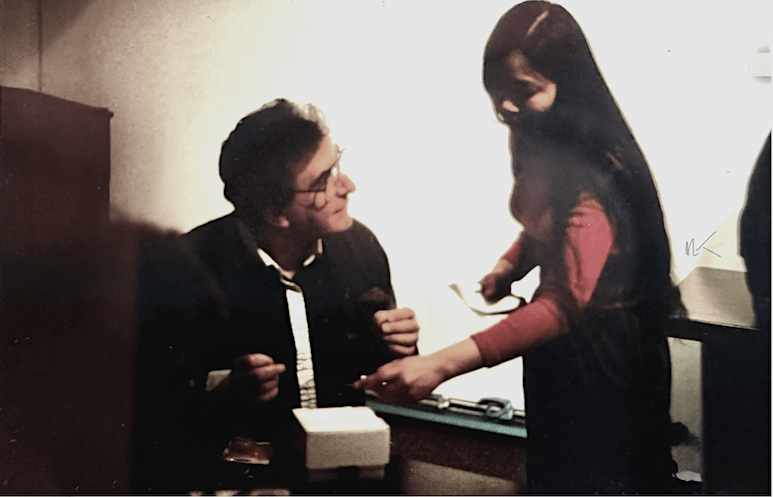
Marlene Krueger’s body of work is a masterclass in technological curiosity and artistic execution. Rather than treating light as a static element to illuminate an object, Krueger treats light as the object itself. Her practice relies heavily on custom-engineered electronic devices, built entirely from scratch, which manipulate polarization filters and motorized prisms. The result is a series of kinetic light sculptures that constantly shift, fracture, and rebuild themselves before the viewer’s eyes. This intricate fusion of physics and visual art directly mirrors the foundational philosophy of E.A.T. (Experiments in Art and Technology), positioning her as an essential voice in modern media art.
Education as an Art Form
Beyond the gallery space, Krueger’s inventions have served a profound dual purpose within academic and community spaces, including her impactful tenure teaching in the Chicago public school system. Recognizing that traditional mediums often failed to captivate distracted or at-risk youth, she introduced her complex kinetic light machines into the classroom. By blending structural engineering, mathematics, and optical science with visual design, she created a high-stimulus curriculum that re-engaged students. Her philosophy treats education not as a passive lecture, but as an active, multi-sensory experiment.
A Lasting Chicago Legacy
Krueger’s ongoing dialogue with light and motion continues to inspire creators across disciplines. By grounding her highly technical practice in deep empathy and public community engagement, she proves that complex technology is at its best when democratized. Whether viewed through an academic lens or experienced as pure, shifting color, her light inventions remain a testament to the power of cross-disciplinary creation.