
Capturing History at Pacific Grove
The Monterey Peninsula is known for its dramatic coastlines, cypress trees, and rich maritime history. Although few vantage points capture the intersection of art, history, and science quite like the view from Lover’s Point Pacific Grove. A single photograph taken from this iconic rocky outcrop can tell a story that spans over a century of American marine biology.
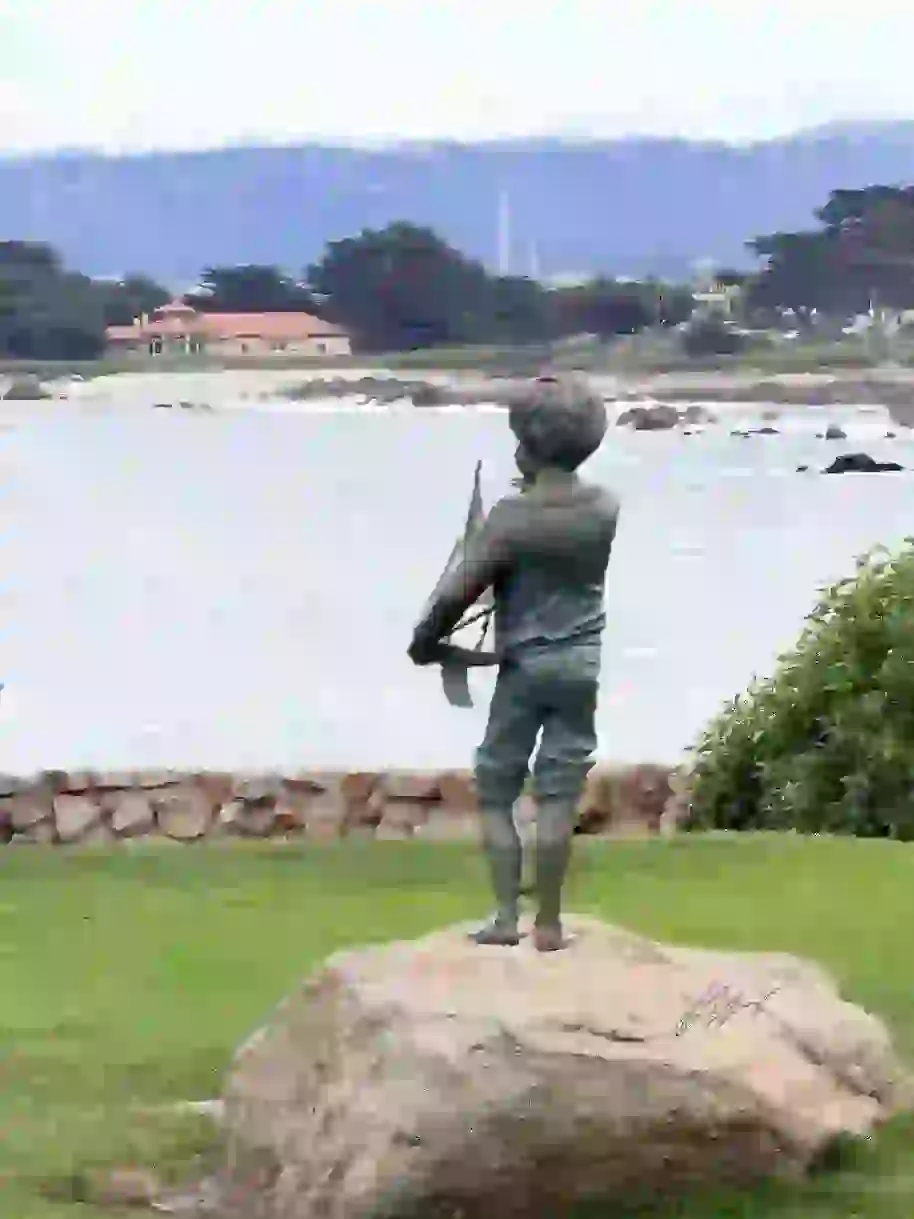
If you stand at eye level near the shoreline, your camera can frame a stunning visual narrative: a detailed bronze statue of a young boy holding a toy sailboat in the foreground, looking directly across the glittering waters of Monterey Bay toward the historic Hopkins Marine Station and the Monterey Bay Aquarium, with the hazy silhouettes of distant mountain ranges anchoring the horizon.
The Focal Point: “Yesterday’s Dream — Tomorrow’s Memory
Every great photograph needs a strong anchor, and at Lover’s Point Monterey, that anchor is a weathered bronze sculpture created by artist Dorothy Fowler in 1990. Titled “Yesterday’s Dream — Tomorrow’s Memory,” this evocative piece depicts a young boy completely focused on holding up his model sailboat, pointing it out toward the vast Pacific Ocean.
In the photograph, the statue serves as a brilliant compositional tool. With his back slightly turned to the camera, the boy acts as a surrogate for the viewer. His gaze directs our eyes across the waves, bridging the gap between the nostalgic, human element in the foreground and the grand scientific institutions operating in the midground. The earthy, muted tones of the bronze and the surrounding granite rocks contrast beautifully with the deep blues and greens of the California tidepools.
The Midground: A Century of Marine Biology
Looking past the statue’s outstretched arm, the eye travels across the water to Cabrillo Point. Here sit two institutions that fundamentally changed our understanding of the ocean:
Hopkins Marine Station of Stanford University: The sloping rooftops visible across the bay mark the current campus of the oldest marine laboratory on the American Pacific Coast.
Monterey Bay Aquarium: Located just adjacent to the lab, this world-class institution occupies the historic site of the old Hovden Cannery, seamlessly blending modern conservation science with Cannery Row’s industrial past.
For photographers and travelers, this view is a visual reminder of how deeply embedded marine conservation is within the culture of the Central Coast.